By Greg Twinney, CEO, General Fusion
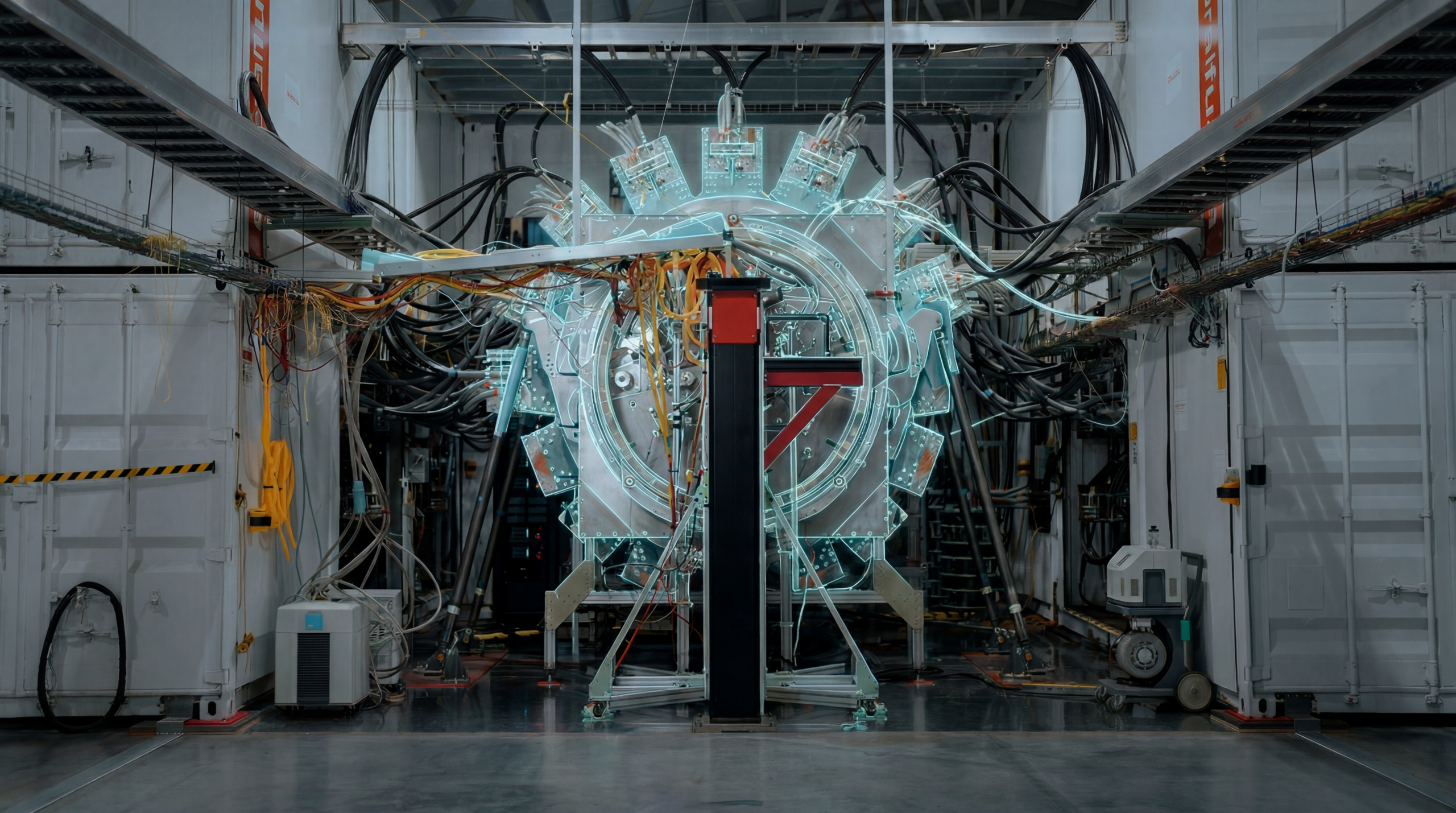
The promise of fusion is extraordinary: a new source of clean, reliable energy that could power the world on a scale we can barely imagine today. General Fusion was founded to turn that promise into practical power plants. That means solving the physics of fusion in a way that can eventually be built, operated, and repeated economically. Today, we announced a major step forward on that path by demonstrating 1 keV, more than 12 million degrees Celsius, inside our latest, largest, most commercially relevant fusion demonstration machine ever, Lawson Machine 26 (LM26).
LM26 has reached electron temperatures exceeding 1 keV, more than 12 million degrees Celsius, along with meaningful ion heating, using our Magnetized Target Fusion (MTF) technology. The electron temperature result was measured with the UK Atomic Energy Authority (UKAEA).
You can find our technical papers and links to our joint announcement with UKAEA here, and an expanded overview of the results here.
This is a significant result, unique to the industry in many ways. There is still hard work ahead, but this is the kind of real progress that moves fusion, specifically General Fusion, closer to the grid than ever before.
Here’s what we did, why it’s a big deal, and where we go from here.
Here’s what we achieved: a world-first for low-speed plasma compression!
LM26 heats a large-scale magnetized plasma by compressing it with a metal liner moving at relatively low-speed, operating in a “sweet spot” of physics parameters which we believe will be necessary in commercial power plants. When we launched LM26, we set 1 keV electron temperature as our first major goal because it’s an industry-recognized milestone that only a few fusion companies have achieved in any way. We knew that achieving it with our practical approach to fusion at this scale would fundamentally validate what we’re doing and how we’re doing it. No one has reached 1 keV with practical low-speed compression. We did it!
And we wanted to know if we could trust our temperature measurement. So, we worked hand-in-hand with UKAEA to design, install, and commission a gold-standard Thomson scattering system, and we measured electron temperature in our machine together. Thomson scattering gives us a very accurate, robust measurement in space and time. We also used another system, called AXUV, to measure electron temperature even deeper into the plasma, and saw consistent readings between the two measurements. That’s important!
Additionally, we wanted to see ions heating up meaningfully during the plasma compression, as electron temperature rose. We did that, too!
Taken all together, we saw plasma temperature, density, and magnetic field all increase as expected—a consistent, corroborated picture of a plasma that stayed stable and got hot through low-speed compression alone—our core MTF approach.
In plain terms: we squeezed a plasma shaped like a cored apple, and it stayed alive while we squeezed it and heated up to more than 12 million degrees. Multiple instruments agree. Each step of that is hard. Doing it all together, at a commercially relevant scale, with a technology designed from the outset to lead to a practical fusion power plant—that’s the accomplishment. That’s what we did.
The “how” matters: the beauty of low speed
Our Magnetized Target Fusion technology, from day one, was designed to become a power plant: practical, durable and cost-effective. The key is our metal wall technology that compresses a magnetically confined plasma and drives the fusion. It doesn’t use lasers or other extreme gear to compress it quickly (in nanoseconds). It uses a metal wall to compress it slowly (in milliseconds). That lower speed makes all the difference! Low speed means less required power, less complexity, and less cost. And, in our commercial machine, it means we can rely on a liquid metal wall to protect the machine from neutrons, breed fuel, and efficiently capture heat to create steam and spin a turbine—to solve key challenges to commercializing fusion power.
Achieving 1 keV in LM26 demonstrates the underlying principle of low-speed plasma compression. This result is unique to General Fusion. It’s a beautiful thing! This approach to demonstration pays off financially now, too. LM26’s flexible, nimble design lets us produce real technical results faster and at a fraction of the cost of larger machines. We have an entrepreneurial culture that knows how to move fast, iterate, and optimize the risk retired per dollar spent, because the world doesn’t need the most expensive fusion program; it needs practical fusion power.
This isn’t a physics result in isolation. It’s evidence that our fundamental approach, designed from day one with practicality and cost in mind, is progressing exactly the way we want it to!
Here’s what’s next
These results are a key milestone and a major steppingstone on our path to commercial fusion. There’s more to do. Our next target for LM26 is 10 keV (roughly 100 million degrees Celsius) through compressional heating. Now that we’ve achieved the 1 keV milestone, we’re moving ahead with planned upgrades to LM26 to hit the higher compression ratio and plasma density that 10 keV requires. After 10 keV, we’ll focus on the Lawson criterion, which is the combination of plasma temperature, density, and confinement time that can produce net fusion energy in the plasma and is targeted by the end of 2028.
As we’re making progress with LM26, we’re also looking ahead to our commercial systems program, which we aim to start soon. Ultimately, our goal is to operate a first-of-a-kind (FOAK) fusion plant around 2035.
We still have real work ahead: 10 keV, then Lawson, commercial systems, a FOAK plant. But today is exactly what it looks like: a real, measured, world-first step forward.
Step by step. Milestone by milestone. That’s how we get to practical and transformative fusion power.
Certain statements in this blog are forward-looking statements under U.S. Securities laws. These include statements regarding the Company’s ability to commercialize MTF or other fusion technology, expected timelines, future demand for fusion energy, the LM26 program, financing needs, and future operational or financial results. Forward-looking statements are based on assumptions and involve risks and uncertainties, many outside the Company’s control. Actual results may differ materially, and readers should not rely on these statements as guarantees, assurances, or predictions of future performance. Important information regarding these statements, including the full cautionary disclosure, is available at https://generalfusion.com/disclosures/.