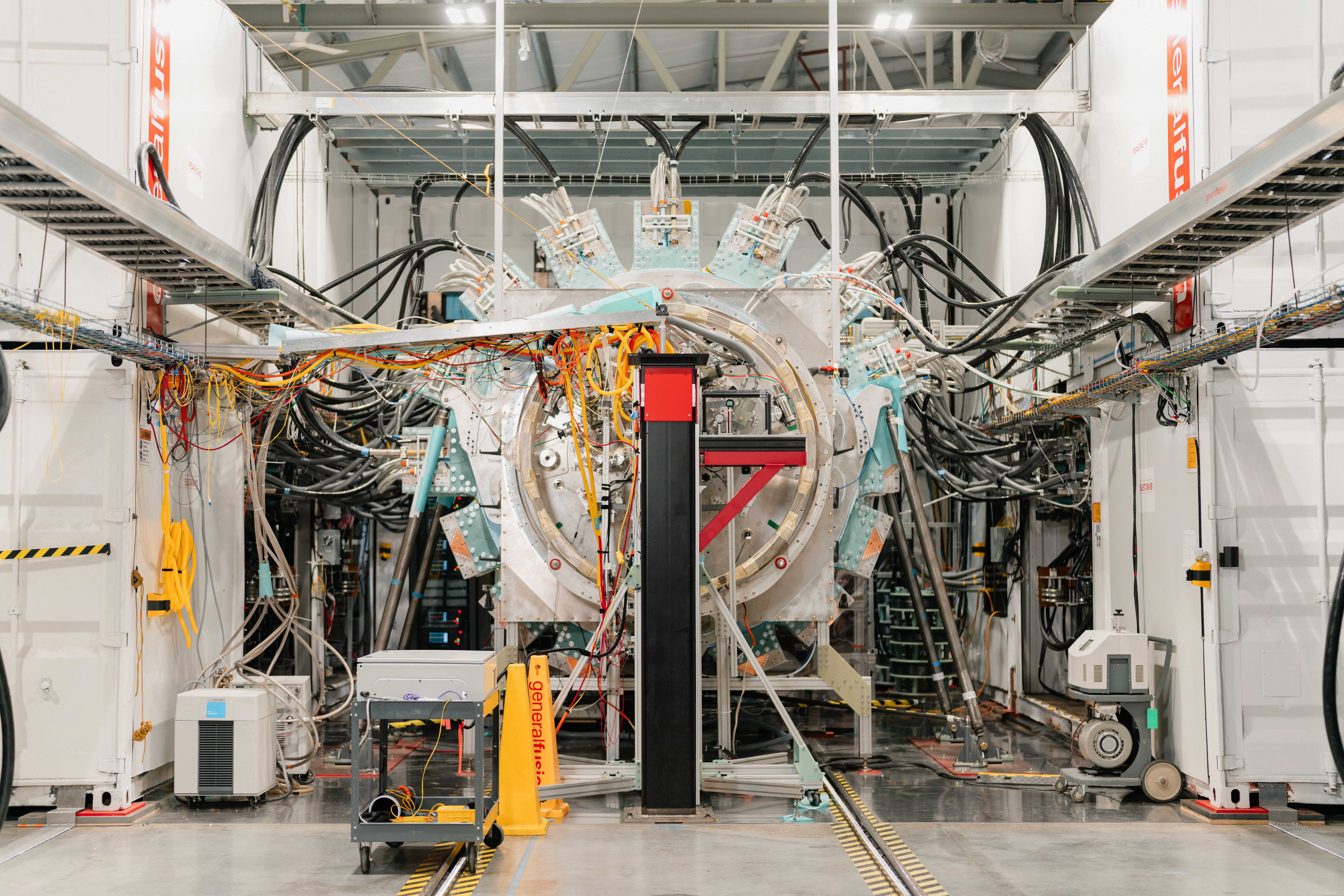
The Lawson Machine 26 (LM26) operating at General Fusion has demonstrated compressional heating of a spherical tokamak deuterium plasma as it was compressed by an imploding solid lithium liner. Results from the first 11 compression experiments on LM26 are presented, the highest performing of which show more than a three-fold increase in electron temperature, a ten-fold in crease in density, and a ten-fold increase in poloidal field in the plasma driven by three-fold radial compression. The experimental device and its instrumentation are reviewed in detail, followed by direct observations from each of the key diagnostics for liner trajectory and plasma properties, measuring increases in magnetic field, electron density, as well as emission of neutrons, X-rays, and visible radiation. Observations from fast-camera images during compression provide detailed context for interpreting the spatial structure of plasma-wall interaction. Overviews of the various models developed and used in the analysis are presented. Diagnostic data are used to reconstruct the exper imental equilibrium state in computational modeling as a function of time. The results indicate the reconstructions are sufficiently accurate to match the essential observations from the experiment, validating the models and building confidence in the stability and transport analyses that support the key conclusions. Trends across the full set of 11 compression shots are presented, and a more detailed examination of the high-performance shots are given individually. The key conclusions of the integrated physics model specifically indicate that compressional heating was achieved in this set of experiments, as evidenced by the balance of heating power from compression, Ohmic heating from plasma current, and losses to the boundary necessary to match the experimental data. A majority of the increase in temperature is attributable to compressional heating. An increase in neutron flux is also observed during compression. The results provide a basis for planned improvements to the LM26 facility that will enable the compression of magnetized plasma to increasingly higher densities and temperatures.
News & Insights
Submitted for Peer Review: The Science of Compressional Heating on the LM26 Magnetized Target Fusion Machine
June 22, 2026