Abstract
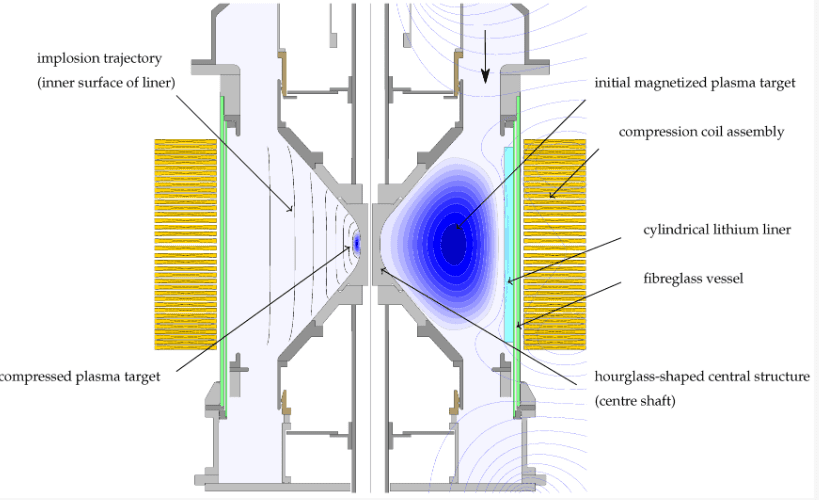
Electromagnetic implosions of hollow lithium cylinders can be utilized to compress magnetized plasma targets in the context of Magnetized Target Fusion (MTF). Two small-scale experiments were conducted at General Fusion as a stepping stone toward compressing magnetized plasmas on a larger scale. The first experiment is an electromagnetic implosion of a lithium ring, and the second is a compression of toroidal magnetic flux by imploding a hollow lithium cylinder onto an hourglass-shaped central structure.
Here we present the methodology and results of modelling these experiments with OpenFOAM. Our in-house axisymmetric compressible MHD multi-phase solver was further extended to incorporate: (i) external RLC circuit model for electromagnetic compression coils and (ii) diffusion of the magnetic field into multiple solid materials. The implementation of the external RLC circuit model for electromagnetic coils was verified by comparison with results obtained with FEMM software and with the analytical solution. The solver was then applied to model both experiments and the main conclusions are as follows: (i) modelling solid lithium as a high-viscosity liquid is an adequate approach for the problems considered; (ii) the magnetic diffusivity of lithium is an important parameter for the accurate prediction of implosion trajectories (for the implosion of the lithium ring, higher values of magnetic diffusivity in the range 0.2 ≤ ring[m2/s] ≤ 0.5 resulted in a better fit to the experimental data with a relative deviation in the trajectory of ≲20%); (iii) simulation results agree well with experimental data, and in particular, the toroidal field amplification of 2.25 observed in the experiment is reproduced in simulations within a relative error margin of 20%. The solver is proven to be robust and has the potential to be employed in a variety of applications.
Victoria Suponitsky, Ivan V. Khalzov, David M. Roberts, Piotr W. Forysinski
Published: 25 August 2025 in Fluids MDPI